Tag Archives: poem

You Heal Me: A Poem by Collette Kristevski

You ask me for poetry
as a gift.
I tell you,
I’m sorry,
but I cannot give you poetry.
You ask me why.
And I answer:
Because I don’t know how to write about
what does not hurt.

//You Heal Me
//Collette Kristevski, 4/5/2019

Shout out to my husband who doesn’t drive me to need to emotionally vomit all over paper in order to cope or process. If you are in a relationship that requires tons of angsty poetry for you to survive it, perhaps you should re-evaluate. Trust me, I’ve been there. I once was the self-proclaimed queen of angsty romantic poetry. It wasn’t a flattering look for me.

Forgiveness: A Poem by Collette Kristevski

Even psychology,
even religion,
even philosophy,
even poetry;
despite the deepest plummets into
conscious
and unconscious;
and given my unrelenting introspection,
attempts at humility,
apologies,
amends,
prayers
and penance;
even with a tight grip on grace,
divine love,
salvation
and sanctification;
and though I remember Your words:
that I must forgive to be forgiven –
I still cannot forgive myself.
And I pray that
forgiving everyone else is enough.
Have mercy on me,
for I have forgotten
how to have mercy on myself.

//Forgiveness, 4/5/2019
//Collette Kristevski

Right or Wise?: A Poem by Collette Kristevski

You can color within the lines
but cannot paint a portrait.
You can read music
but cannot improvise a tune.
You may be right,
but that does not make you wise.

//Right or Wise?, 4/2/2019
Collette Kristevski
@paradoxandpaschalia

Whatever knowledge I ever possessed (or thought I possessed) never prepared me for life or made me wise. I fear that all it did was make me, at least for a time, intolerable and also intolerant. Being right and being wise are not always the same thing.

Quid est veritas?: A Poem by Collette Kristevski

“What is True”
so readily resists being grasped.
Perhaps Truth
refuses to be decisively grasped
so that questions never cease.
Perhaps this is the Truth
that is more nearly True:
that sometimes we can learn more from curious questions
than from solid answers.

//”Quid est veritas?”
//Collette Kristevski, 4/3/2019

Pilate therefore said to Him, “Are You a king then?” Jesus answered, “You say rightly that I am a king. For this cause I was born, and for this cause I have come into the world, that I should bear witness to the truth. Everyone who is of the truth hears My voice.” Pilate said to Him, “What is truth?” And when he had said this, he went out again to the Jews, and said to them, “I find no fault in Him at all.

John 18:27-38

This is one of my favorite exchanges in Scripture. For quite a while I was on a spiritual journey, and my question was, like Pilate’s, “what is Truth?” There is speculation that Pilate’s question is actually one of jest and mockery of Jesus’ claim to be witness to the truth. Maybe it was. But I like to think that Pilate’s question was mainly a philosophical one or a curious one. What is truth? Jesus did not answer. Perhaps because Pilate did not stay long enough for the answer. Perhaps he didn’t want to know the answer. Or perhaps Jesus did not answer, and his non-answer WAS the answer. Either way, I think the question “what is truth?” or “what is true?” is crucial. What is Truth (capital T) to you? Is there such a thing?

Background taken from PicsArt.

Religion: A Poem by Collette Kristevski

I like my poetry like…
A wine, bitter but honest.
A bread, leavened.
A meditation with your eyes open.
A prayer with closed lips.
A confession disclosed.
And if I speak of poetry
like some speak of religion,
please understand…
there was a time when
poetry was the only way
I could commune with God.
It was my silent amen.

//Religion
//Collette Kristevski, 4/2/2019

Convenience: A Poem by Collette Kristevski

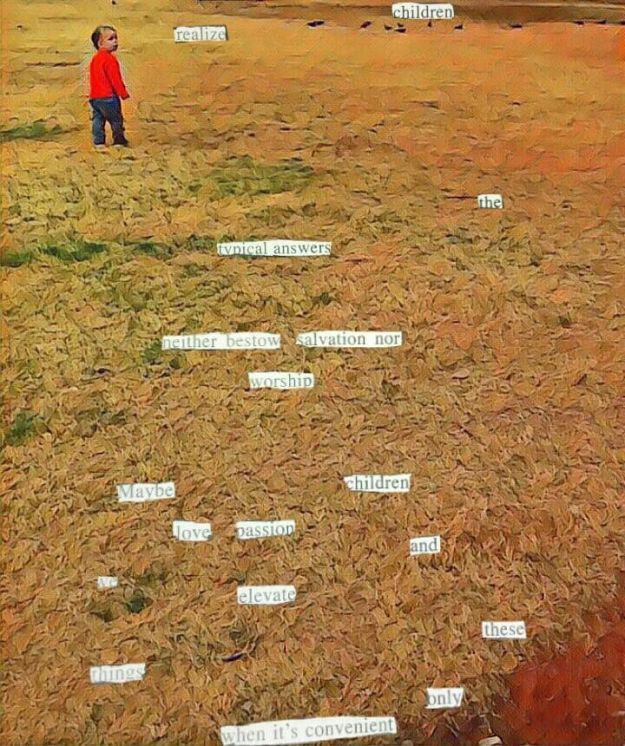
Children realize
the typical answers
neither bestow
salvation nor
worship.
Maybe children
love passion,
and we elevate
these things
only when it’s convenient.

//Convenience
//Collette Kristevski, 3/28/2019

This is an original blackout poem. Photo taken by me and edited with PicsArt.

Follow me on Instagram @paradoxandpaschalia for more original poetry and art.

Partake: A Poem by Collette Kristevski

The poet does not create beauty,
as in “bring into existence.”
Beauty exists.
Beauty woos,
beckons
the poet to Itself.
The poet is simply privileged
to partake of It –
to participate with It
in the illumination of some Truth:
that Beauty exists on It’s own.

Partake
Collette Kristevski, 3/30/2019

I was inspired to write this poem while thinking about beauty and it’s significance. As someone who writes poetry and does some drawing and painting, I would like to think that I’m the type of person who is able to see beauty in seemingly mundane, everyday things – even things that are obviously imperfect. However, I am also a tidy, clean and perfectionistic person, and often want to “perfect” what does not live up to my ideal. But when I am able to reframe imperfections in my environment as having meaning and beauty somehow, it becomes less burdensome on me, and lessens my intense need to tidy up or perfect things. On further examination though, I’ve come to recognize that beauty is not necessarily created, but that it exists on it’s own, apart from any creating or perfecting on my part. I just don’t always have the eyes to see it. The Greek adjective “kalos” is an interesting word because it can be rendered as “beautiful” or as “good.” In the Orthodox Christian faith, which I am a part of, we elevate beauty sort of as an all-encompassing term to refer to not just what is beautiful, but also what is True and Good. It refers, ultimately, to God Himself and to His will or purpose for His creation. In fact, the most primary text about Orthodox spirituality is called the Philokalia, which means “love of beauty.” And so I was pondering what it means to create art since art is often referenced as a means by which we create beauty. Perhaps art, in the most genuine sense of the word, is not art because someone made something beautiful, but because through the “creating” of the art, the artist was actually participating with the beauty that was already present. They simply illuminated it, or made it more obviously available, for all to see. Now, I definitely don’t claim to create art in this genuine sense. But it is a worthy standard to aspire to. If I can make art that gives a sense of enormity and infinity, of what is God and True and Beautiful – only then can I claim to be an artist or poet.

Follow me on Instagram @paradoxandpaschalia for more original poetry and art.

“It is finished”: A Blackout Poem by Collette Kristevski

The burden and cares laid aside.
Hear the flight
of the beasts of man –
his pride, sin, despair.
Renew
the heavenly things.
Restore
that which was lost.

//”It is finished”

//Collette Kristevski, 3/28/2019

This is a blackout poem. Background taken from PicsArt.

Follow me on Instagram @paradoxandpaschalia for more original poetry and art.
I am still mystified: A Poem by Collette Kristevski

There is Something
more immense
than I have ever been able to account for.
I have sensed since childhood
Something
abysmal,
mystifying,
unnameable.
To claim to be able to see,
to name,
to know –
I am embarrassed
to say I ever did.

//I am still mystified
//Collette Kristevski, 3/29/2019

For more original poetry and art follow me on Instagram @paradoxandpaschalia.

Immortality: A Poem by Collette Kristevski

What is man
if not both body and soul?
Not two divided parts,
but insperable energies within a single undivided whole.
So when the bots come to consume your mind,
don’t pretend you didn’t know.
We were warned of this transfer of consciousness long ago.
But this is not the resurrection of which we’ve been told.
A mind within a metal house is not progress, just ego.
But the serpent of Eden is disguised,
and he says that you won’t die.
So we leave Eden again,
become less and less authentic,
less human with our technological sin.
Whether a computer hive mind
or metal shell to hold the soul,
when it comes down to survival, I guess anything goes –
your soul for transcendence, a quid pro quo.
Immortality is real, but it’s not just for the fittest.
Christ said it’s for the least of these,
but you gotta fight to get it.
And if He foresaw the promise of immortality
placed on conveyor belts and displayed behind glass,
God still would have become fully human and defeated death.
In a world where conscious technology is already how things go,
who can you trust?
The Immortal One or the “holy” status quo?

//Immortality
//Collette Kristevski, 3/26/2019

This poem is inspired by a prompt given by @thethoughtreserve on Instagram. Coming in with an Orthodox Christian take on the problems of technology, transfer of consciousness and survival. I’m no doomsdayer, but consciousness and its interplay with technology is a topic I’ve been interested in for a while, and it’s getting pretty concerning out there. This is not the type of poetry I usually write, but I enjoyed the challenge. Hopefully it will give you all some food for thought.